
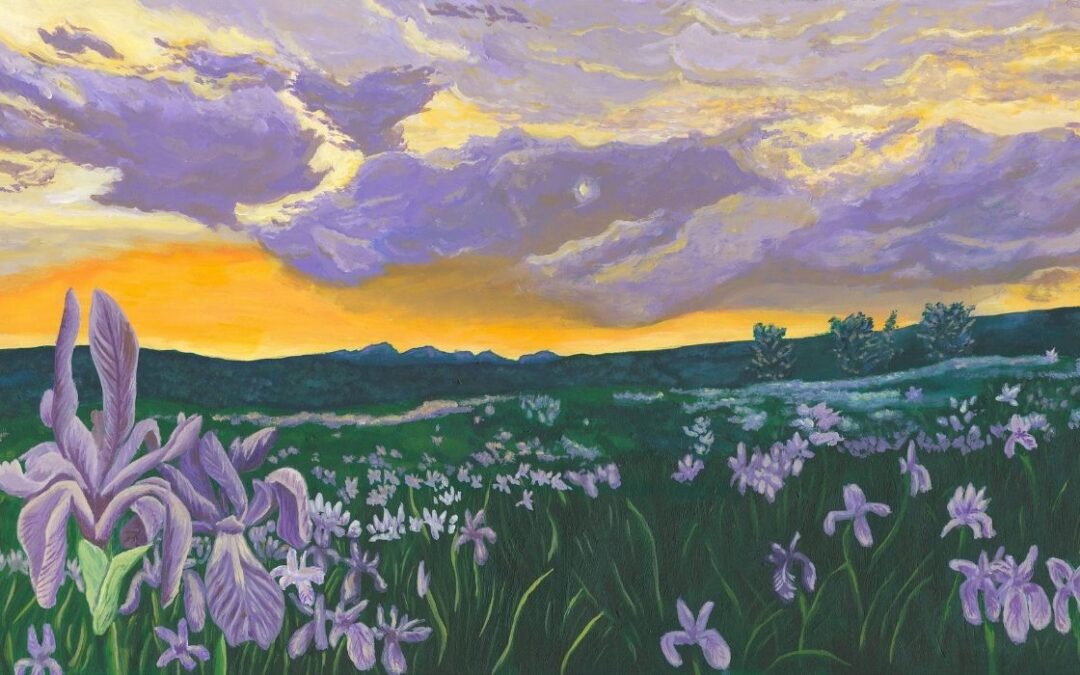
After days of dry basin walking in Wyoming’s Great Divide Basin, Monica Aguilar and her partner crested a rise and saw the Wind River Range stretching across the horizon ahead of them. Below, a meadow of wild mountain irises spread out at their feet—a sudden explosion of color after miles of sage and dust.
“We hadn’t seen any real water in a while,” Monica recalled. “And then you could just see the Wind River Range up ahead and it was just so beautiful.”
For most thru-hikers, this would be a moment to stop, take a photo, and soak it in. For Monica, it was all of that—plus a mental note that she’d be painting this scene later. As an artist who carries watercolors in her pack alongside her food and shelter, Monica sees the Continental Divide Trail through a lens most hikers don’t: not just as a path to walk, but as an endless series of subjects waiting to be captured in color.
Triple Crown, One Paintbrush
Monica is a triple crown thru-hiker—she completed the Appalachian Trail in 2018, the Pacific Crest Trail in sections between 2021 and 2024, and the Continental Divide Trail northbound in 2025 with her partner. She also biked the Great Divide Mountain Bike Route southbound in 2019, which first introduced her to the landscapes of the Divide—and produced a painting journal she still has today. Six years later, walking the same terrain on foot, she could see how her style and skill had grown, even as the same artist shone through. Back home in New England, she works at a bus garage two days a week, a setup that gives her the flexibility to travel, hike, and focus on her growing art practice.
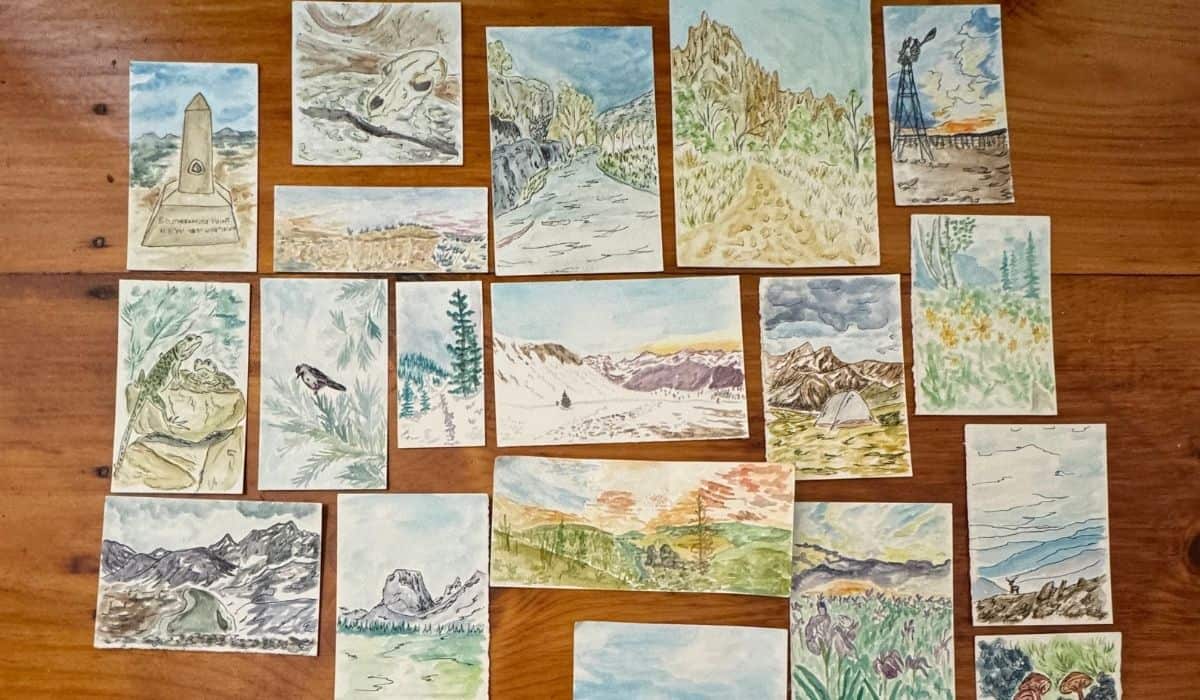
Her style? She calls it “semi-realistic with a little bit of whimsy.” She favors vibrant, slightly unexpected colors—purples in places purple may not technically belong—that capture the feeling of a moment rather than a photographic reproduction of it. The shift from bike to foot changed her subject matter, too: the 2019 bike ride paintings featured more road and bike-related scenes, while her CDT work is almost entirely nature-based. In the studio, she works primarily in acrylics on canvas and has recently gotten into block printing. On trail, she scales down to watercolors, painting small 4×6 and 5×7 pieces that get mailed home in resupply boxes.
The Continental Divide Trail Through an Artist’s Eye
Painting on a thru-hike is harder than it sounds. When you’re hiking big miles day after day, the energy to sit down and create doesn’t always come easily—and Monica is honest about that tension.
“I’m not the fastest hiker, so it’s kind of like a full-time job for me to be out hiking. There were definitely times I was doing it a lot more and then other times that I wasn’t. You want to be doing it for the joy of it—you don’t want it to become another chore on the list.”
Most of her on-trail painting happened in town during resupplies or on the rare zero day, and during the early desert miles when the pace was slower. When thru-hiking, she aimed for about one painting per resupply section—roughly one to two per week. Her partner’s mom helped with logistics, mailing fresh paper in resupply boxes and receiving finished paintings back. Monica sent pieces home partly to lighten the load, but also because she liked the idea of someone at home watching the terrain and seasons shift with each new batch of paintings.
Prioritizing painting during the hike—rather than waiting until it was over and the logistics were simpler—was a deliberate choice. Since turning art into a career through murals and window painting, Monica had found it difficult to create just for herself. She wanted the CDT to be a starting point for painting without worrying about the results. She also journals daily on trail, and the paintings help her remember specific locations and core memories in a way that a journal entry alone can’t. She likes that the on-trail pieces are a little less polished—they show a story. But even when the brush stayed packed, the artist’s eye was always at work—scanning the landscape for compositions, taking reference photos with the clear intention of painting them later.

And the Continental Divide Trail gave her no shortage of material. Near the Gila in southern New Mexico, she found a sun-bleached animal skull that became a desert still life. In another stretch of New Mexico, she caught a moment where the sun was setting on one side of a wide valley while the moon rose on the other—a panoramic scene she’s now painting on a 12-by-36-inch canvas back home.
Not every painting tells the story you might expect. Monica laughed about a few of her Colorado pieces, painted during the early weeks when the pair started a bit too early and got caught in heavy spring snow in the San Juan Mountains.
“There are some paintings where it looks really pretty and picturesque and I was like, I was freaking out that day. I was having a bad day. But the painting—you can’t tell.”

Choose Your Own Adventure
Having completed all three of America’s long-distance National Scenic Trails, Monica has a unique vantage point on what makes each one special. She thinks she did them in the perfect order: the Appalachian Trail first for its social scene and forgiving learning curve, the Pacific Crest Trail next for its middle ground, and the Continental Divide Trail last—the one that demanded the most and gave back in equal measure.
“I feel like the CDT really challenges you in that way where there are these really cool areas like the Wind River Range, but then also there’s 50 miles of road walking and you have to take both. You get the good with the bad.”
Where some hikers in her year felt the trail was too quiet or took shortcuts past the less glamorous sections, Monica leaned in. She considers herself a purist—she walks the road sections, and finds something worthwhile in them, whether it’s a farmer stopping to check in, a good podcast, or simply the rhythm of forward motion. At the same time, having her partner along gave her the confidence to go off-trail and explore in ways she might not have alone—venturing into the Gros Ventre Range, tackling parts of the Wind River High Route, and finding the kind of choose-your-own-adventure freedom that the CDT is known for.
Her favorite sections? The Wind River Range and Gros Ventre area in Wyoming. The Bob Marshall Wilderness and Glacier National Park in Montana. And she had a clear message about a state that many CDT hikers tend to rush through or underestimate.
“New Mexico is really an unsung hero. There’s a lot of variable terrain and canyons, and such kind people. All the farmers would stop and check in on us.”
She also had a reassuring message for anyone intimidated by the Continental Divide Trail’s reputation. Despite expecting far more harrowing conditions, she found the trail surprisingly accessible—a testament, perhaps, to the rerouting and trail improvement work that land managers and organizations like the Continental Divide Trail Coalition (CDTC) and its partners have invested in over the past two decades.

Painting It Forward
For Monica, art isn’t just a personal practice—it’s a way to give back to the trail that has shaped her life. She reached out to CDTC because she wanted her work to do more than hang on a wall. She hopes it can connect people to the CDT who might not otherwise know about it, inspire them to get outside, and support the trail’s future.
“My hope is that people see my travels and my artwork and they’re inspired to do some of that on their own—creating in these beautiful spaces, or just going out and going for a hike.”
She’s donating a piece for an upcoming CDTC auction, and she has a larger vision of her trail art as a bridge between the outdoor community and the creative community—two worlds that overlap more than people might think.

A Challenge: Go Create Something
When asked what she’d want readers to take away, Monica didn’t talk about trail tips or gear lists. She issued a challenge.
“I think there’s a lot of people that are like, ‘I’m not a good artist,’ or ‘I can’t draw a stick figure.’ You don’t have to be the best artist. Just playing around with color and shapes and how you see it—or how your hand thinks you see it, because it sometimes isn’t the same as what’s in your head—I challenge people to use the trails and being outside as a launching point to create.”
It’s an invitation worth taking up. And Monica makes a convincing case that the barrier to entry is lower than you think. Her on-trail kit is simple: a pencil, a pen or two, a couple of water brushes, a small watercolor set, an eraser, hand-cut paper held between two pieces of cardboard with an elastic, and a gallon zip-lock bag to hold it all.
Start with a goal that feels achievable, she advises—and don’t be hung up on results. Next time you’re out on the Continental Divide Trail—or any trail—consider packing a small sketchbook or a set of watercolors alongside your water filter and your trail mix. You don’t have to be Monica Aguilar. You just have to look, and try.
About Monica Aguilar
CDT Thru Hiker (2025)
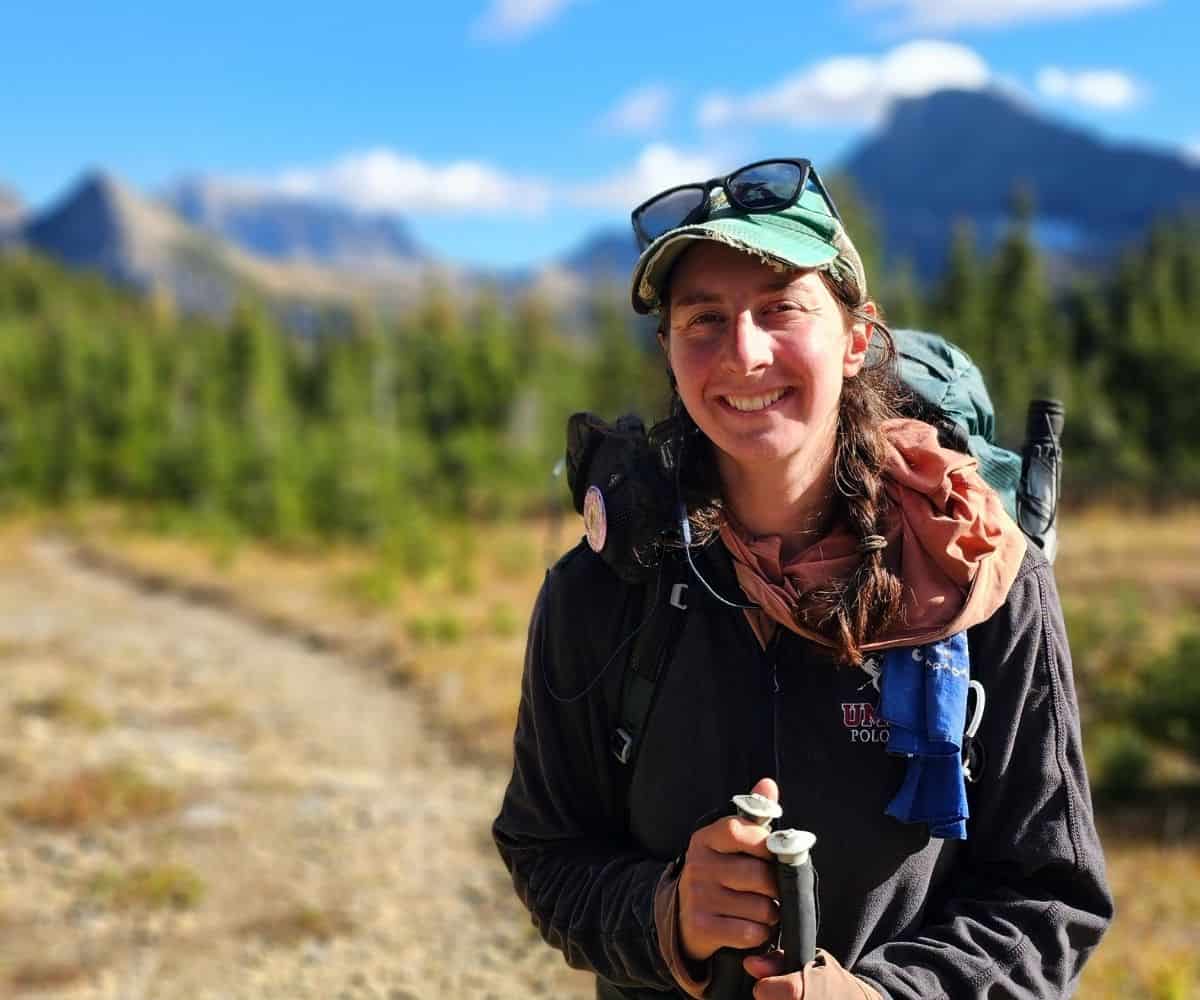
Monica Aguilar is a triple crown thru-hiker and artist based in New England. She completed the Continental Divide Trail northbound in 2025 and creates trail-inspired artwork in watercolor, acrylic, and block print.
You can find her work at https://www.instagram.com/chasingtrailsart/.
Share Your Story: Be a Voice of the Divide
Ready to inspire the next generation of hikers, volunteers, and supporters? Share your unique CDT story, photos, or trail art with the CDTC for a chance to be featured in an upcoming “Voices of the Divide” blog post, social media spotlight, or other CDTC content.