
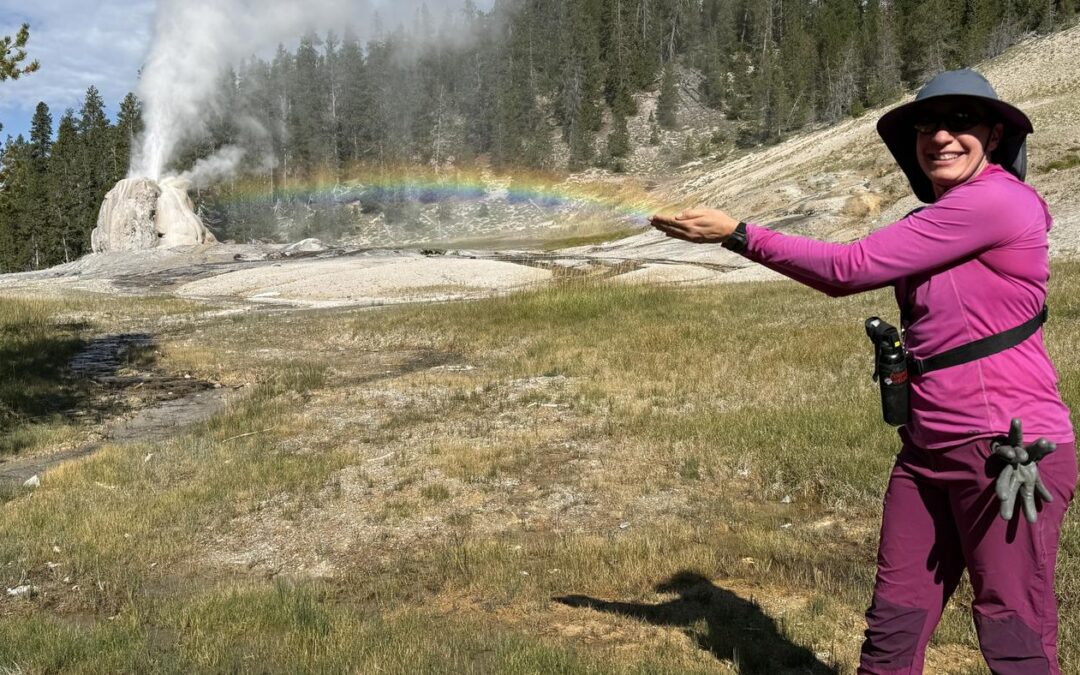
The first time Melissa Prager’s coworkers heard how she spends a week of her vacation, they did not quite get it. She had come back from Yellowstone, where she had spent the week sitting in the backcountry dirt with an eight-pound hammer, breaking rock. A crew leader had looked over her pile, decided the rocks were not broken down small enough, and sent her back to it.
“My coworkers were a little bit like, so you just banged on rocks,” she told me. “I’m like, yes. I made big rocks into littler rocks. And then they came and judged us and said they weren’t little enough, so we hit them more. And that’s what we did for the week.”
She would not trade it for anything, and the more we talked, the more I understood why. Melissa is a manager at Microsoft who spends 80 to 90 days a year outside, enough of them that she tracks the total in a spreadsheet, with pivot tables sorting her backpacking days from her mountaineering days. For three years running, some of those days have gone to the same stretch of the Continental Divide Trail in Yellowstone, near the Fire Hole Geyser, where she has been helping rebuild a boggy section of trail one rock at a time.
She knows exactly how rough that section is, because she walked it first.
The part she hated
In 2019, Melissa thru-hiked the CDT. She picked it on purpose. It had a reputation as the hardest of the long trails, and her knees, she figured, were not getting any stronger, so she should do it while they could still handle the up and down. It was a brutal year to choose. A historically high snowpack meant roughly five weeks of walking on snow in Colorado, neoprene socks, wet feet, and the steady low-grade worry of trench foot. The crowd of northbound hikers she started with scattered. Some flipped, some bailed, some pushed up into Wyoming and doubled back. For a couple of days in the snow, she was completely alone.

Somewhere in Yellowstone, she hit a marshy stretch that took more out of her than the mileage suggested, the kind of slipping, sucking trail you do not forget. She filed it away.
Then she finished, went home, and started getting our emails about volunteer projects. One of them was in Yellowstone, near the Fire Hole. The idea arrived fully formed: she could go back and fix the part of the trail she hated.
“I really do want to go back and work on that section of trail,” she said. So she did, and then she kept doing it.
What she found, season after season, was the trail changing under her hands. She remembers when planks were the only way across the marsh, then the crew built the crib, and then there was finished tread where there had been bog.
“It’s one of those ‘we built this’ sort of moments,” she said. “I remember when we had planks going across this because it was a muddy marsh, and then they built the crib.”

It was never only her work, and she is quick to say so. Youth crews and agency partners put in time on the same stretch between her visits, so what she sees when she returns is what the whole community built while she was back at her desk. That, she says, is part of what makes coming back so satisfying.

The math of giving back
Melissa’s support doesn’t stop when she leaves the trail after a project.
“I love doing my week of trail maintenance,” she said, “but I’m a middle-aged woman who is mostly working a desk job.” Showing up with a hammer, she figures, is one kind of contribution. There is another she is just as deliberate about. She has come to see her giving as running on two tracks: showing up, and funding the people who can do what she cannot.
To keep that second track in front of her, she keeps her W-2 taped behind her monitor in her home office. On the days when the meetings stack up and the afternoon disappears, it reminds her that the paycheck can build trail.
“Me showing up to a trail work thing is going to be a radically different amount of contribution than if I instead give money,” she said, “and they’re able to hire young college grads that maybe had a forestry degree and really need that time outdoors.”
She gives so we can hire the people who need the work and have the training to do it well. She gives so there are people who can travel to Washington and speak up for the trail, which she calls a force multiplier for everything else. It is a way of turning hours at a desk into work she will never personally do.
“That helps keep me motivated on days when I’m just like, why am I sitting through my seventh hour of meetings today,” she said.
The community she didn't go looking for
The other thing Melissa did not expect to find was people.
That first year in Yellowstone, she showed up not knowing a soul on her crew. By coincidence, two of the other volunteers were from Ankeny, Iowa, near where she had spent her high school years. The group clicked. Now it is largely the same crew that returns season after season, a reunion she looks forward to all year.
“Now it’s like a good reunion with people that I can’t wait to see every year,” she said.
It is a pattern that started on the trail and never really stopped. During her thru-hike, she fell in with two younger hikers who could kick steps through the snow while she brought the avalanche awareness she had built over years of mountaineering and backcountry skiing. They made a good team. They have visited her since, and they have climbed together since. She has another friend who simply says yes to adventure, whom she talked into a mountaineering course, then into cat skiing every February, and finally into a week of CDT trail maintenance every August.
When Melissa describes what the CDT gave her that she never planned for, she lands where almost everyone I talk to eventually does.
“That is what maybe the CDT actually is,” she said. “Community.”

A call to live
There is a reason Melissa moves through all of this the way she does, generous with her time, her money, and her hard-won experience. It did not come up until late in our conversation, and when it did, it caught me off guard. The people who have spent years on trail crews beside her did not know it either.
Melissa came to the outdoors late. She did not sleep outside for more than a single night until her mid-thirties. What set her in motion was loss. Her younger sister was paralyzed in a snowmobiling accident, and that, Melissa says, became a call to live. Her sister did not slow down either. She went on to hand-cycle marathons, Boston, Berlin, and more, and she collected hundreds of medals. Last fall, she was hit and killed by a truck while crossing a trail in rural Iowa.
Melissa carries her with her. “Every summit I stand on, I’m aware that this is a place that she can’t get to,” she said. It is also why she keeps returning to a belief she states plainly, almost matter-of-factly, as though it should be obvious to everyone.
“You never know when life is going to be done,” she said. “There’s no perfect time. Sometimes you just make it be good enough.”
That belief is the engine underneath the spreadsheet, the W-2, and the eight-pound hammer. Melissa believes, deeply, that people need to connect with nature, and that doing it immersed in a place, only ever walking a single direction, is something close to magical. She wants that to still be there for the people who come after her. Protecting the trail, with her hands and with her giving, is how she helps make sure it will be.
“I believe it’s so important for people to connect with nature,” she said. “Doing it on day hikes is great, but doing it in an immersive environment where you are only ever walking a single direction is pretty magical, and I want to make sure that it’s still available for folks.”

Just try it
I asked Melissa what she would say to someone who knows the CDT, is curious about volunteering, but is not sure they are the type.
She did not overthink it.
“Just try it,” she said. “The people are great. Being connected with nature is so important for our mental health, and this is an awesome way to both get to do it and contribute to making it better.”
We’re so lucky to get to do this, she told me near the end, reflecting on what it feels like to be out there. The trail is how you get there. People like Melissa are how it stays.
Want to follow Melissa’s lead? Find an upcoming volunteer project on the CDT at cdtcoalition.org/get-involved/volunteer/.
Photos courtesy of Melissa Prager.
Share Your Story: Be a Voice of the Divide
Ready to inspire the next generation of hikers, volunteers, and supporters? Share your unique CDT story, photos, or trail art with the CDTC for a chance to be featured in an upcoming “Voices of the Divide” blog post, social media spotlight, or other CDTC content.