
By Scott Neumeier and Mathias Klingemann, CDTC GAOA Trail Crew
After two dry, dusty weeks in the Gila, our Great American Outdoors Act (GAOA) trail crew at the Continental Divide Trail Coalition (CDTC) packed up and traded the desert for the greener pastures of the San Pedro Parks Wilderness in the Santa Fe National Forest, outside Cuba, New Mexico. We spent June split across two hitches and two very different kinds of work on the Continental Divide Trail (CDT): first brushing back miles of overgrown tread, then clearing the downed logs blocking the corridor.
At a Glance
- When & where: Two June hitches. San Pedro Parks Wilderness and the CDT just south of it, near Cuba, NM
- Brushing: Overgrown spruce corridor limbed and brushed back, plus drain work
- Range: 9,500 to 7,500 ft, through mixed conifer, Gambel oak, ponderosa, and piñon-juniper
- Tools & training: Borrowed a 3-ft crosscut from the Santa Fe NF office. Learned TACOS trail surveys (ArcGIS) in the Carson NF

Hitch one: brushing back the corridor
Our first hitch started with a bang. Seconds after we found our dispersed campsite, a hailstorm rolled in that could have been dangerous had we already been out working. Luckily we still had the truck, and we passed the time catching up. Daniel, our GAOA Program Manager, joined us for the first two days, a welcome fifth set of hands since our saw-training hitch.
While our earlier hitches emphasized drain and tread work on badly incised trail, this stretch was about the very epitome of deferred maintenance: brushing. We spent the first two days working up to and past the San Gregorio reservoir, where the wide, well-loved trail made for easy brushing but demanded robust drains. It was a pleasure to trade stories with day hikers on a trail so clearly valued by the people of Cuba and greater New Mexico.
To give the inner wilderness the attention it deserved, we hiked about 5.5 miles in and set up camp overlooking a meadow where the CDT meets the remote Anastacio Trail. From there we worked north for two full days of limbing and brushing, opening up long sections that would have been miserable for any equestrian. The Blue and Engelmann spruce here push long limbs into the corridor, sometimes half a foot or more, forcing travelers to plow through or shove them aside. As we worked, we talked through lopping ethics: where and how to cut, how to disperse the slash, and how to weigh efficiency against the health of the trees.
For northbound thru-hikers, this lush pocket often arrives like a fleeting dream. Most spend only half a day in it, but after hundreds of miles of cactus and low desert, the green is a sight for sore eyes, the first taste of the northern New Mexico and southern Colorado high country to come.
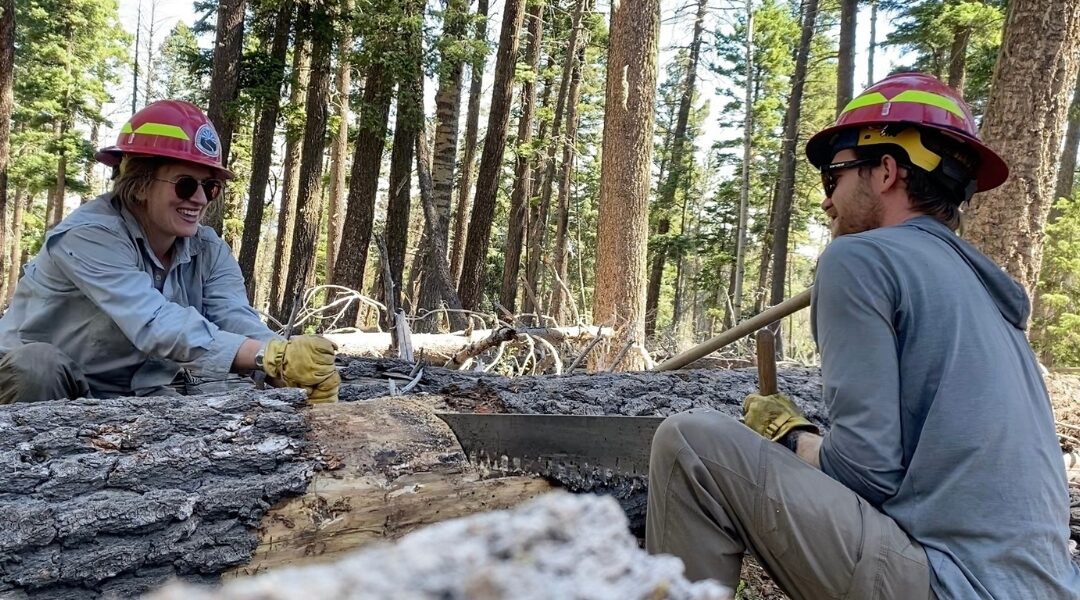
We hiked out and moved to our final camp near the Cecilia Springs trailhead, on the northern end of the wilderness. Reaching our work area meant four miles of steady climbing and 2,200 feet of gain, with more brushing, blowdowns, and hangups waiting. Because this is designated wilderness, we cleared the logs with hand tools, our crosscut and a Silky Katanaboy, to protect the quiet and the wildlife. It’s been a wonderful way to grow as thinking sawyers. All week we’d listened to the afternoon thunderstorms grumble past as empty threats, until our final day, when a series of small lightning storms crept too close and pushed us off the trail. We’ll be back next hitch to finish the job.

 Before
After
Drag to compare
Before
After
Drag to compare

 Before
After
Drag to compare
Before
After
Drag to compare

 Before
After
Drag to compare
Before
After
Drag to compare
Hitch two: opening it up
When we returned at the end of June, we shifted from brushing to logout, working two sections of the CDT: one south of the San Pedro Parks Wilderness and one within its northern reaches.
On the southern stretch between San Pedro Parks and Cuba, we broke out the chainsaws for the first time this season and cleared 18 downed trees from the corridor. As the trail drops from 9,500 feet at the San Gregorio reservoir to 7,500 feet at the base of the Knife’s Edge, it moves through mixed conifer and Gambel oak, into a healthy ponderosa stand, and finally into piñon and juniper, remarkably diverse country for a six-mile hike. With the corridor open again, we’re already looking ahead to tread widening and outsloping on the Knife’s Edge next hitch.
For the northern section inside the wilderness, we based out of the lovely Cecilia Creek trailhead and went back to hand tools. John, at the Santa Fe National Forest office in Cuba, generously lent us a three-foot crosscut saw that was a pleasure to carry on the hike in. It’s the kind of partnership that makes this work possible.

On our final day in the field, we met up with Tambi, our GAOA program manager, Dan, our Trails and Lands program manager, and Jesse, a GAOA field technician, in the Carson National Forest near Canjilon to learn TACOS, the Trail Assessment and Condition Overview Survey. A day of trail scouting with Dan, our resident TACOS expert, showed us how the ArcGIS app records and reports the work we accomplish.
After a midseason summer break, we’re excited to get back to the Santa Fe for another hitch, with the Carson waiting for us after that. There’s plenty of trail left to open up, and we can’t wait to get back to it.
Explore More
The Great American Outdoors Act (GAOA) is a historic investment in public lands across the country, including the Continental Divide National Scenic Trail. Learn how it’s helping us address deferred maintenance through all five states along the Divide.